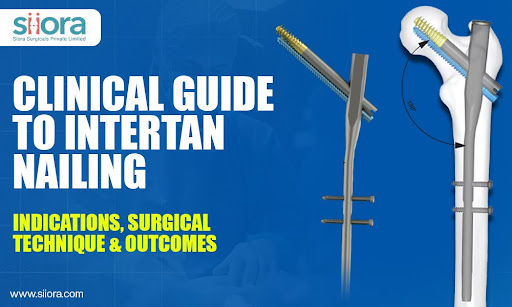
Hip fractures are among the most common challenges faced in orthopedic trauma, especially in older patients with fragile bones. While many fixation devices exist, one system that has stood out in recent years is the Intertan nail. Known for its unique geometry and integrated dual-screw design, it offers better rotational control and stability compared to many traditional implants. In this guide, let’s take a closer look at when to use Intertan, how the surgical technique is approached, and what outcomes can be expected in real-world practice.
Indications: When is Intertan Nail the Right Choice?
Not every hip fracture calls for the same implant, so understanding the indications is key. The Intertan nail is primarily designed for:
- Intertrochanteric fractures, especially unstable or comminuted ones.
- Certain subtrochanteric fractures where intramedullary support provides more reliable stability than plating.
- Cases of osteoporotic bone, where cut-out risks are high with traditional lag screw systems.
Its dual integrated screw system is particularly useful in fractures at risk of rotational displacement or collapse. For a surgeon, it essentially means one implant that can handle a wide spectrum of complex proximal femur injuries with confidence.
Surgical Technique: Step by Step in the Operating Room
Now, let’s talk about how the nail is actually inserted. While the exact approach may vary slightly depending on surgeon preference, a general flow looks something like this:
- Patient positioning
Typically, the patient is placed supine on a fracture table. Traction is applied to align the fracture fragments under fluoroscopic guidance.
- Entry point & canal opening
A small incision is made, and the entry point is established just lateral to the tip of the greater trochanter. Gentle opening of the canal helps make way for the nail.
- Reaming the canal
Sequential reaming allows for smooth nail passage. Many surgeons use flexible reamers here because they reduce stress on the cortex and help match the nail size more precisely.
- Nail insertion
The Intertan nail is advanced carefully along the prepared canal. Its unique curvature often makes this step easier than older straight designs.
- Integrated interlocking screws
This is where Intertan sets itself apart. Two screws, placed simultaneously into the femoral head, lock together inside the nail. The result? Superior rotational control compared to single-screw systems. This design resists “cut-out,” one of the common complications of hip fixation.
- Distal locking
Depending on the fracture type, distal screws are placed to secure the implant further.
- Closure & recovery
Small incisions are irrigated and closed. With minimally invasive technique, post-op pain and healing time are reduced.
Key Benefits in Clinical Use
So why go through the effort of using Intertan instead of a more conventional fixation? Here are a few of the main advantages, observed time and again in practice:
Rotational stability: The dual-screw construct prevents femoral head rotation, encouraging more reliable healing.
Early mobilization: Secure fixation allows patients, even elderly ones, to begin weight-bearing sooner—a huge factor in preventing complications.
Reduced risk of implant failure: By distributing stress more evenly, the design lowers screw migration or breakage.
Versatility: Suitable for both stable and unstable fracture configurations.
Outcomes: What Does the Evidence Say?
When we look at clinical outcomes, many studies and real-world reports highlight improved union rates and fewer mechanical failures with Intertan compared to conventional nails. Patients treated with Intertan nails often experience:
- Fewer reoperations due to hardware complications.
- Faster return to walking, which is critical for elderly individuals at risk of complications from immobility.
- Comparable or reduced surgical time, once the learning curve for the dual-screw insertion is mastered.
Of course, like any implant, Intertan isn’t the answer for every fracture. Extremely proximal fractures or patients with narrow femoral canals may pose challenges. That said, in the right cases, it consistently delivers strong outcomes.
Final Thoughts
The Intertan nailing system is more than just another intramedullary device, it represents an evolution in how we approach difficult proximal femur fractures. Its integrated screw design directly addresses the shortcomings of earlier nails, offering surgeons a tool that combines stability with efficiency.
From a practical standpoint, patients benefit from shorter recovery times, surgeons appreciate the decreased risk of revisions, and healthcare systems save costs through reduced complication rates. For anyone managing proximal femur fractures, Intertan orthopaedic implant is a system worth knowing well.
 Siora Surgicals Pvt. Ltd.